A To-Do List for Ambiguous Times
Being not NOT a post about the state of the world...

I’ve been quiet, this last month. Processing, I think. Assessing possible courses of action in light of known and unknown events.
That tends to be how I deal with crises: I find things to do. The day my mother died, I was the one who called all the relatives and wrote the obituary and sorted things with the funeral home. When a friend is having a crisis, my mind starts spinning plans: resources I could share, items I could fill a care package with, ways I might be able to arrange a surprise visit. When something “happens,” there will (almost) always be to-do lists. There will almost always be obvious ways to help.
When the “crisis” is more nebulous—when the thing you’re reacting to is uncertainty about what comes next—the to-do lists are a little less clear. And life has a lot of uncertainty right now. We’re living in ambiguous times.
This was true for my family even before the election. The tech layoffs caught up with us earlier this fall, which has opened up a lot of questions—not just “where is our money going to come from?” (the way S put it the other day) but also how my partner and I approach base assumptions about where we want to live, what kind of jobs we want to have, what kind of lifestyle we actually want. What’s important to us.
Our kids’ school situation has begun to raise some of the same questions, more so with each passing year. Even before we knew we had two demand-avoidant autistic kids, the question of how we wanted to educate our family was one we went round and round on. Trying to prioritize our contradictory goals and values—strong public education is important, we don’t want our five-year-old to have homework, we want our kids to be part of a neighborhood community, we want our kids to grow up believing that art and music are just as important as math and reading—stressed me out for literally years. For the moment, both kids attend a local (private) Waldorf school, R in a part-time kindergarten program (very flexible, going great) and S in “mainstream” second grade (less flexible, going not-so-great). But the question of what will be best for them in six months or a year is still open, and there won’t be certainty on whether we made the “right” decision even after it happens.
I’m in my early 40s now. I’m slowly coming to terms with the fact that the world is complex and multifaceted and imperfect, and more often than not, checklists aren’t that helpful. It’s hard to know what call to make.
But after a month of sitting with all this ambiguity, and reading and thinking and talking and reading some more, I’ve still managed to put together a to-do list, of sorts.
A lot of these suggestions come from post-election reflection pieces (which I will add links to below as I find them—I’ve done a lot of reading this month), and I’d invite you to apply them in that context, but not only. Because I think they work equally well for smaller-scale ambiguous moments, and God knows adult life has plenty of those.
And so, my to-do list, for this exceptionally ambiguous moment:
Challenge your assumptions. Everyone has biases and unquestioned beliefs about how the world works, what’s going to happen tomorrow or next week or next year, how work and school and home life and relationships are “supposed” to go. Most of this stuff is a lot less predetermined than most of us believe it to be, for better or for worse. Most things have space to change.
Consider your hard truths. For those of us disappointed in the election results, this might look like sitting with what it means that almost half of those who voted on November 5th made a choice that we couldn’t fathom making, and about a third of eligible voters didn’t vote at all. For me as I consider my kids’ school journey, it might mean confronting the fact that the beautiful educational model I was drawn to when S was a toddler may not be the right fit for her anymore.
Connect with your community. When I realized I was autistic, and was struggling to figure out what that meant, I tapped into the autistic adult community on social media. When I started thinking seriously about homeschooling, I found a local homeschool group and started taking my kids to meetups. When I feel overwhelmed about the state of the world or worried about what might happen after the inauguration next year, I plan in-person events with my neighbors, because local community is protective in all kinds of ways. Because everything is easier when you know you’re not alone.
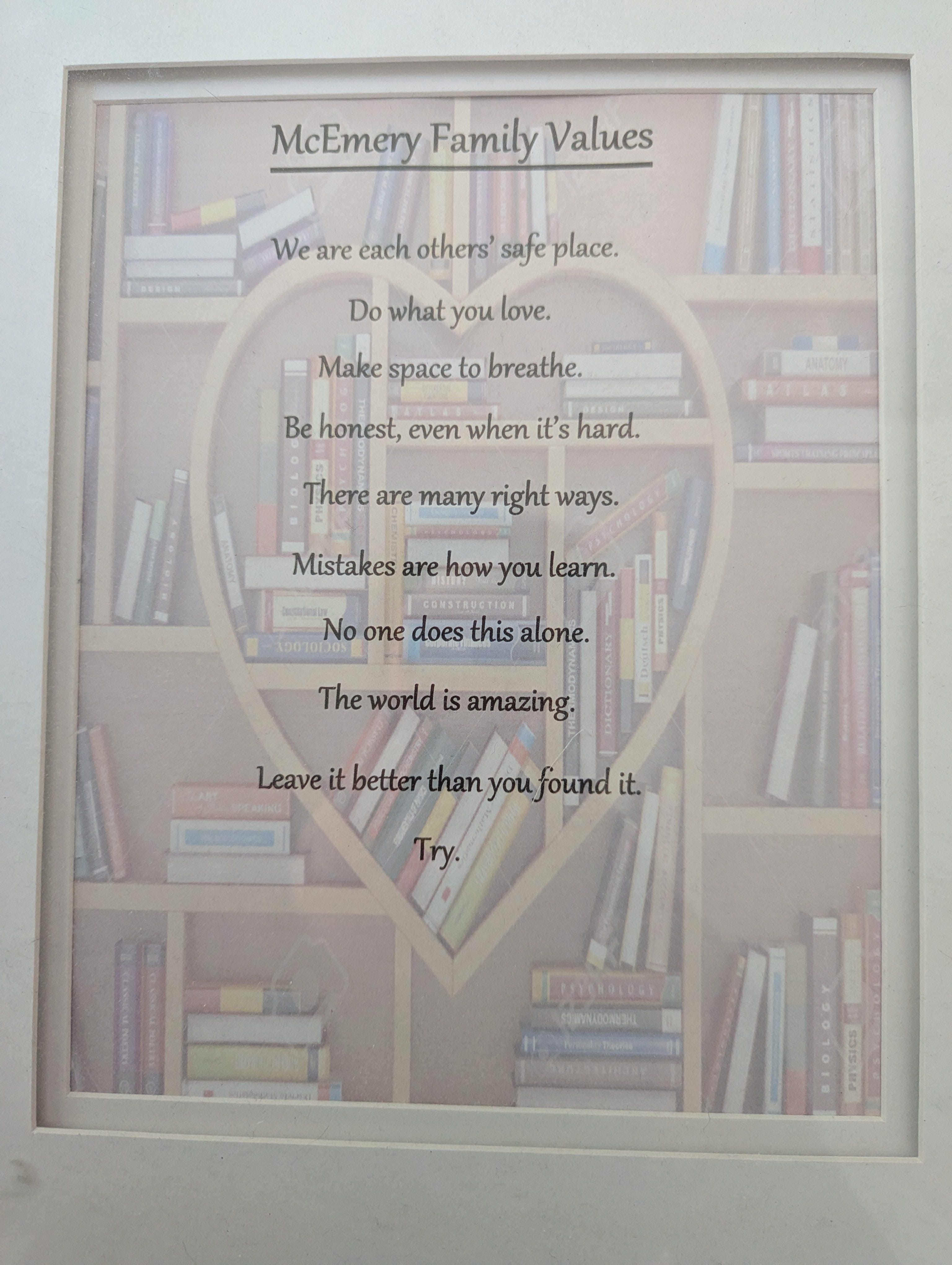
Know who you are. When my kids were much smaller, I used a journalling/free association worksheet to come up with our list of family values. Now, that list usually hangs over the fireplace in our dining room. It’s usually just part of the wallpaper, but sometimes, we pull it out and talk about it. What does it mean that our family believes the world is amazing? What does it mean that one of our family mottoes is “Try”? As we move forward with all our complicated decisions, I hope that trying to keep our family values in mind will help guide our way.
Hang in there, friends. We may be headed for interesting times, but that doesn’t mean we have to go there blind. Always make sure you’ve got your towel, and your to-do lists, and your friends.