
Things I'm Reading, 2/14/25 Edition

On the advice of a fabulous friend, I’m thinking I might try for shorter, more frequent posts for a bit. I’m still figuring out what I’d like to write about here, so feedback is always appreciated!
As I try to get back into more intentional media use, my reading for the last couple weeks has been a mix of old favorites and new thought-provokers. I’ve been pulling from my shelf of favorite books as bedtime reading, and slooowly working my way through my giant TBR pile at the same time. So here are a few things that have been bouncing off each other in my brain over the last week or so…
The Thessaly trilogy, by Jo Walton (comprising The Just City, The Philosopher Kings, and Necessity). Like a lot of Jo Walton’s books, it’s a wildly original concept that goes off in its own direction and never really looks back: in this case, her starting question is “What if the gods Athena and Apollo decided they wanted to create The Just City as described in Plato’s Republic, and collected a bunch of Platonic scholars from throughout history and a bunch of ten-year-old enslaved children from the classical period and just dropped them there?” It speaks to my sociological worldbuilding brain. Each book raises its own sets of interesting questions, the biggest of which is what happens when ideals collide with reality, but the series also has things to say about free will, aliens, AI, and what we learn from being mortal.
This series made me realize that one of my favorite unlikely genre fiction subgenres is “books where the gods are characters.” Jemisin’s Inheritance Trilogy is another fabulous fictional example of this. Gods and mortals bumping into each other and trying to figure each other out is always interesting to me.
Animorphs by KA Applegate. My favorite ’90s book series (first books came out June 1996; I was thirteen, the same age as the characters) which I’ve recently started listening to as audiobooks. I binged Books 2 and 3 last weekend while working on a big house project, and dang, these books are a different experience as an adult. Yeah, they have cool cover art (I grabbed a few covers below), and lots of fantastic descriptions of running around in animal bodies; they’re also about middle school kids waging guerrilla warfare against a numerically superior enemy, and they don’t pull their punches. The one-sentence plot summary for the series: five kids discover that Earth has been invaded by parasitic brain slugs, and that it’ll be years before the “good guy” aliens return, and then are gifted alien technology that allows them to morph into animals and told that they’re Earth’s only hope until the good guys show up again. If they ever do.
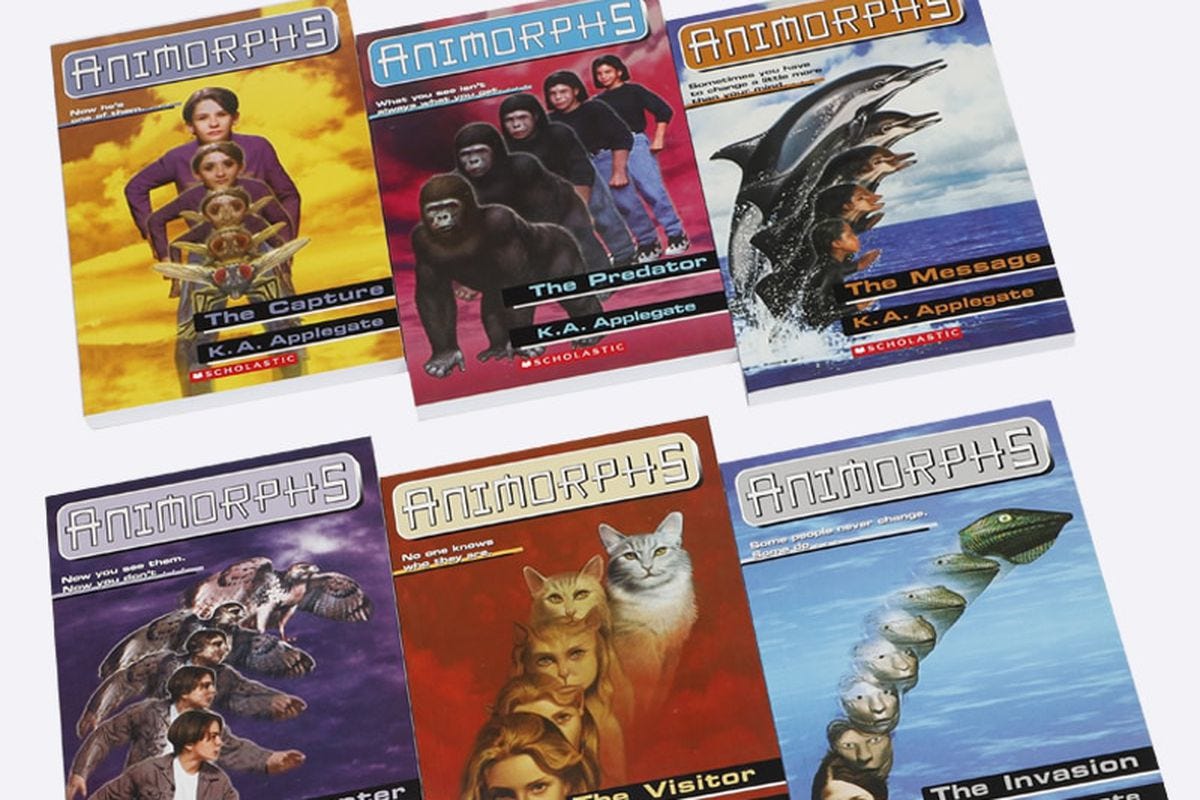
Urge to draw parallels to the current political situation aside… these books get dark, and intense. The main plot arc in Book 2 includes the narrator realizing that both of her best friend’s parents are “Controllers” (hosts to alien slugs who puppet their bodies like in the Robert A. Heinlein book), and then seeing the parents rebel against their slug masters, fighting their own bodies, to protect their daughter. One of the kids is trapped in an animal body—a red-tailed hawk—at the end of the first book and stays that way for the rest of the series, and in Book 3, the overwhelm of that gives him suicidal ideation. None of this stuck with me when I was thirteen.
Will I be sharing these books with my kids? Absolutely. Will I be doing it any time soon? Heck, no.
Hope in the Dark by Rebecca Solnit. Another audiobook, this one one that I’ve been listening to in snippets since the election. It was written during the early years of the second George W Bush administration, and even the new foreword only goes as far as 2016—but it’s still exactly what I need in these times. Basically, she uses historical examples (focused on the 20th century and the West) to make the point that assuming you’ve lost is as foolish as assuming you’ve won; that progress isn’t linear, that small individual actions can have unexpected rippling consequences, and that if history has one constant it’s change.
Rebecca Solnit has written a bunch of books (I’m also working my way through her A Paradise Built in Hell but don’t feel like I’m far enough in to have things to comment about just yet) and also has a very active Facebook presence and a new newsletter. If you’re not following her, and you want a voice of reason curating and interpreting current events for you, I can’t recommend her more highly. For a representative example, the week of the 2024 election, she wrote this:
They want you to feel powerless and to surrender and to let them trample everything and you are not going to let them. You are not giving up, and neither am I. The fact that we cannot save everything does not mean we cannot save anything and everything we can save is worth saving. You may need to grieve or scream or take time off, but you have a role no matter what, and right now good friends and good principles are worth gathering in. Remember what you love. Remember what loves you. Remember in this tide of hate what love is.
You can be heartbroken or furious or both at once; you can scream in your car or on a cliff; you can also get up tomorrow and water the flowerpots and call someone who's upset and check your equipment for going onward. A lot of us are going to come under direct attack, and a lot of us are going to resist by building solidarity and sanctuary. Gather up your resources, the metaphysical ones that are heart and soul and care, as well as the practical ones.
People kept the faith in the dictatorships of South America in the 1970s and 1980s, in the East Bloc countries and the USSR, women are protesting right now in Iran and people there are writing poetry. There is no alternative to persevering, and that does not require you to feel good. You can keep walking whether it's sunny or raining. Take care of yourself and remember that taking care of something else is an important part of taking care of yourself, because you are interwoven with the ten trillion things in this single garment of destiny that has been stained and torn, but is still being woven and mended and washed.
The House in the Cerulean Sea by TJ Klune. A book that’s sat in my TBR pile for I’m pretty sure years, which I picked up because it was recommended for people who’d enjoyed Becky Chambers (who deserves her own post in this space, my favorite new author of the last ten years by a huge margin). Firmly in the category of “cosy genre fiction,” this one tells the story of a social worker who works for the Department in Charge of Magical Youth who’s sent to investigate a suspect group home that (surprise!) is full of charming, loving—but unusual—children and a charming, good-looking foster dad. A gentle queer romance and a deeply sweet story with no real darkness in it except for the prejudice of the town against the unusual children.
This was another book that feels like it’s accidentally-on-purpose fitting for our current moment, with the Department’s 1984-esque focus on rules and regulations and the constant mentions of “See Something, Say Something” posters about magical people posted in public places. “Fight against the evils of closed-mindedness” is hardly a new theme in genre fiction, but it occurs to me again how well sci-fi and fantasy books tend to work as reminders that change happens and the little guy triumphs in the end more often than you might think.
The Expanse. I bounced off this series hard a few years ago; it’s been on my radar for a long time because it’s co-authored (two guys writing under a single pseudonym), and most of my most successful writing from the last 20 years has been done in the context of “ok, these are my characters and these are yours let’s put ‘em in a room together and see what happens, ok?” A big story, obviously (each audiobook is about 20 hours); the first one has two narrators and is half detective story and half scrappy Firefly-esque crew being scrappy, in a world where humans have colonized the Moon, Mars, and some of the moons and asteroids in the outer planets. No faster-than-light travel, no alien civilizations, just people being people in a setting where the prejudices are different. The cultural worldbuilding is really interesting and the story’s not bad either.
I’ve found these books most accessible in audiobook format, probably because I can’t skim over the parts that feel initially less-than-engaging but are important for understanding what’s happening a hundred pages later. I’ve finished the first book and am now a few hours into the second one—and I’ve got to say, the story of slow collapse of an existing system (as Earth and Mars sit on the brink of war and unknown forces threaten to disrupt the fragile space-station life in the asteroid belt), and fear about what’s going to replace it, is giving me All The Feelings right now. A lot of things hitting differently than they might’ve a year ago when I wasn’t worried about the US federal government being hollowed out and all our relationships with allies being shredded. Y’know.
So that’s what I’ve been reading to escape from the news. Mostly genre fiction; a lot of it feeling surprisingly relevant to the current moment nonetheless. I might do a “resources” post about how I’m *handling* the news sometime in the next couple days.
What are you reading?
I enjoyed Man in the Queue by Josephine Tey. Great detective audiobook. Tey was a contemporary of Agathie Christie. So if you like Hercule Poirot, give Inpector Alan Grant a go.